
文档目录
自动研究:特征发现
运行一个 autoresearch 循环,提出 TypeSafe 问题,把自由文本转换成数值特征,并利用模型误差来改进一个有监督的 CatBoost 回归器。
非官方中文翻译 · 内容以 英文原文 ↗ 为准 · 同步于 2026-10-15
TypeSafe 问题把自由文本转换成有监督 CatBoost 模型的数值特征;用 autoresearch 循环去发现它们。
CatBoost 需要一张数字表,而一份品鉴笔记并不算。这份实战示例把表搭成围绕笔记的一系列问题,且没有一道是手写的。一个 LLM 负责提出这些问题,TypeSafe 对每一行作答,CatBoost 用这些回答来训练。接下来就是 autoresearch 部分:CatBoost 报告它用了哪些问题、哪些行仍然答错,下一次的提议调用读取这份报告,循环再次启动。
到最后你会得到一个可以指向你自己带标签文本的循环、一条每轮的留置误差曲线,以及一张最终模型最常用问题的表格。
tasting note
    |
    v
38 TypeSafe answers
    |-- 29 score questions x 2 columns = 58
    |     expected rubric level + answer uncertainty
    `--  9 noul questions  x 1 column  =  9
          probability true
    |
    v
67 numeric columns --> CatBoost --> predicted critic score
                                     held-out RMSE: 1.77 points
一个 Score(打分题)答案会变成两列:答案指向的平均评分档位,以及围绕该平均值的离散程度。一个 Noul(是非题)答案就是一个概率,所以是一列。
数据是 2,000 条酒评:输入是品鉴笔记,输出是评论家在 80–100 分制上给出的分数。RMSE 用评论家分数点来衡量预测误差,偏差越大权重越高,越低越好。下表里的所有数字都来自模型和循环都从未见过的 800 条评论。
| 笔记如何变成一个分数 | RMSE |
|---|---|
| 预测训练行的平均分数 | 3.09 |
| 同一个 CatBoost,把品鉴笔记读为词频 | 2.47 |
| 直接向 TypeSafe 问出分数,再做缩放平移 | 2.15 |
| 一次提议调用生成的 18 个问题,没有循环 | 1.87 |
| 五轮循环之后的 38 个问题 | 1.77 |
最后两行就是循环。一次提议调用、在还毫无线索时,就能跑到 1.87。再读四轮自己的最差预测,能跑到 1.77。增益大部分发生在那第一次调用,而它之后的四轮又贡献了多少,下面会继续衡量。
from __future__ import annotations
import json
import os
import random
import textwrap
import urllib.request
from concurrent.futures import ThreadPoolExecutor
from pathlib import Path
from time import perf_counter
from typing import NamedTuple
import matplotlib
import matplotlib.pyplot as plt
import numpy as np
from catboost import CatBoostRegressor
from cooksafe import JsonCache, make_playground_link
from IPython.display import Markdown, display
from typesafe_sdk import Noul, NoulCriteria, Score, TypeSafeClient
matplotlib.use("Agg") # headless render
TYPESAFE_MODEL = "jev-1.12"
FOLDS, REPEATS = 5, 3 # repeats steady the error at this sample size
CATBOOST = dict(
iterations=400,
depth=4,
learning_rate=0.05,
loss_function="RMSE",
verbose=0,
random_seed=0,
thread_count=1,
allow_writing_files=False,
)
client = TypeSafeClient(
# keyless kernels replay the cache
api_key=os.environ.get("TYPESAFE_API_KEY", "cache-only"),
base_url=os.environ.get("TYPESAFE_ENDPOINT"),
timeout=120.0,
)
json_cache = JsonCache(Path("json_cache.json"))
# ----------------------------------------------------------------- the specification
INTENSITY_LEVELS = [
"Not present in this note at all",
"Barely present - mentioned once, in passing",
"Present at a moderate level",
"Present strongly - the note dwells on it",
"Dominant - the note is largely about this",
]
PRESENCE_CRITERIA = NoulCriteria(
true="The note states this or clearly implies it",
false="The note gives no indication of this",
)
# Asking for the score outright: ten quality bands, rescaled onto the 80-100 critic scale.
SCORE_LEVELS = [
"Faulty or unpleasant - the note is mostly criticism",
"Barely acceptable - drinkable, with nothing to recommend it",
"Simple and sound - correct, plain, forgettable",
"Pleasant everyday wine - some appeal, little depth",
"Good - clear varietal character, well made",
"Very good - balanced, with something to say",
"Excellent - complex and structured",
"Outstanding - depth and length, built to age",
"Superb - among the best of its type",
"Profound - the note treats it as exceptional",
]
# Structured output requires every property in `required`, so unused fields come back empty.
PROPOSAL_SCHEMA = {
"type": "object",
"properties": {
"actions": {
"type": "array",
"items": {
"type": "object",
"properties": {
"op": {"type": "string", "enum": ["add", "revise", "drop"]},
"target": {"type": "string"},
"name": {"type": "string"},
"kind": {"type": "string", "enum": ["intensity", "presence"]},
"question": {"type": "string"},
},
"required": ["op", "target", "name", "kind", "question"],
"additionalProperties": False,
},
}
},
"required": ["actions"],
"additionalProperties": False,
}
PROPOSALS = 18 # actions the proposer may return per round
# The one string that knows this is about wine. Point it at your own label and text.
PROPOSER_TASK = f"""You are designing numeric features for a gradient-boosting model that
predicts the score a wine critic gave (an integer from 80 to 100) from the tasting note alone.
The model sees nothing but the features you design.
Return up to {PROPOSALS} actions. Each action is one of:
- {{"op": "add", "target": "", "name": ..., "kind": ..., "question": ...}}
A new feature.
- {{"op": "revise", "target": <name of an existing feature>, "name": ..., "kind": ...,
"question": ...}}
Replace that feature's question with better wording. Use this when a feature measures the
right thing badly: too narrow, too vague, or worded so nearly every note answers the same.
- {{"op": "drop", "target": <name of an existing feature>, "name": "", "kind": "intensity",
"question": ""}}
Remove a feature that is not earning its place.
`kind` is "intensity" for something with a degree, or "presence" for a yes/no fact.
`question` is what gets asked about one tasting note.
An "intensity" question is graded against this fixed five-level rubric, so word it so that the
levels make sense:
{chr(10).join(f" {i}. {level}" for i, level in enumerate(INTENSITY_LEVELS))}
A "presence" question is answered as the probability that it is true of the note.
Good features can be judged from the note's own words, vary from note to note, and carry
information about quality that the other features do not. Reviewers describe structure, fruit,
oak, length, complexity, and drinkability, and they also signal quality through word choice."""
class Split(NamedTuple):
"""The rows, their labels, and which half the loop is allowed to read."""
notes: list[str]
scores: np.ndarray
dev: np.ndarray
test: np.ndarray
# ----------------------------------------------------------------- the data
WINEMAG_CSV = (
"https://huggingface.co/datasets/GroNLP/ik-nlp-22_winemag/resolve/"
"90eb39f35fc64e556fc17f06d4137a4a69ec3297/train.csv"
)
@json_cache
def load_slice(n_dev: int, n_test: int, seed: int) -> dict:
"""Fetch the pinned CSV and take a seeded sample of note + score, one row per note."""
import csv
import io
request = urllib.request.Request(
WINEMAG_CSV, headers={"User-Agent": "typesafe-cookbook/1.0"}
)
with urllib.request.urlopen(request, timeout=300) as response:
text = response.read().decode()
rows, seen = [], set()
for row in csv.DictReader(io.StringIO(text)): # a few notes repeat verbatim
if not row["description"] or not row["points"] or row["description"] in seen:
continue
seen.add(row["description"])
rows.append((row["description"], float(row["points"])))
random.Random(seed).shuffle(rows)
picked = rows[: n_dev + n_test]
return {"notes": [r[0] for r in picked], "points": [r[1] for r in picked]}
def example_rows(split: Split, out_of_fold: np.ndarray | None, n: int) -> list[int]:
"""Select representative dev rows for a proposer round."""
dev = split.dev
if out_of_fold is None:
ranked = dev[np.argsort(split.scores[dev], kind="stable")]
return [int(ranked[round(q * (len(ranked) - 1))]) for q in np.linspace(0, 1, n)]
error = np.abs(split.scores[dev] - out_of_fold)
order = np.argsort(-error, kind="stable")
worst = [int(dev[i]) for i in order[: n // 2]]
best = [int(dev[i]) for i in order[len(order) - (n - n // 2) :]]
return worst + best
def example_block(
rows: list[int],
split: Split,
out_of_fold: np.ndarray | None,
previous: np.ndarray | None = None,
) -> str:
"""Format selected rows for the proposer."""
if out_of_fold is None:
head = "Example notes, with the score each one was given:"
body = [f"- scored {split.scores[r]:.0f}: {split.notes[r]}" for r in rows]
return head + "\n" + "\n".join(body)
head = (
"Dev notes, worst-predicted first. The first half is where your current questions "
"miss by the most and the second half is where they are already right, so what "
"separates the halves is what the questions have not captured."
)
if previous is not None:
head += (
" Each line also carries what the previous round predicted, so you can see which "
"notes your last batch of questions moved."
)
body = []
for r in rows:
line = f"- scored {split.scores[r]:.0f}, predicted {out_of_fold[r]:.1f}"
if previous is not None:
line += f" (last round {previous[r]:.1f})"
body.append(f"{line}: {split.notes[r]}")
return head + "\n" + "\n".join(body)
def load_split(n_dev: int, n_test: int, seed: int = 0) -> Split:
# keyword, because the cache key is the function name plus how each argument was spelled
data = load_slice(n_dev, n_test, seed=seed)
return Split(
notes=data["notes"],
scores=np.array(data["points"]),
dev=np.arange(n_dev),
test=np.arange(n_dev, n_dev + n_test),
)
# ----------------------------------------------------------------- step 1: propose
def proposal_prompt(examples: str, feedback: str, accepted: list[dict]) -> str:
parts = [PROPOSER_TASK, "\n" + examples]
if accepted:
parts.append(
"\nThe features you have now. `add` must not duplicate one of these; `revise` and "
"`drop` refer to one by name:\n"
+ "\n".join(
f"- {f['name']} ({f['kind']}): {f['question']}" for f in accepted
)
)
if feedback:
parts.append("\nHow the model did with those features:\n" + feedback)
return "\n".join(parts)
@json_cache
def propose(model: str, round_index: int, prompt: str) -> dict:
"""One proposal call. Every number in `prompt` is rounded so a replay hits the cache."""
if model.startswith("claude"):
import anthropic
response = anthropic.Anthropic(
api_key=os.environ.get("ANTHROPIC_API_KEY", "cache-only")
).messages.create(
model=model,
max_tokens=16000,
output_config={
"effort": "medium",
"format": {"type": "json_schema", "schema": PROPOSAL_SCHEMA},
},
messages=[{"role": "user", "content": prompt}],
)
body = next(block.text for block in response.content if block.type == "text")
usage = [response.usage.input_tokens or 0, response.usage.output_tokens or 0]
else:
from openai import OpenAI
response = OpenAI(
api_key=os.environ.get("OPENAI_API_KEY", "cache-only")
).chat.completions.create(
model=model,
reasoning_effort="high",
max_completion_tokens=16000,
response_format={"type": "json_object"},
messages=[
{
"role": "user",
"content": prompt
+ "\n\nReply with JSON matching this schema:\n"
+ json.dumps(PROPOSAL_SCHEMA),
}
],
)
body = response.choices[0].message.content
usage = [response.usage.prompt_tokens, response.usage.completion_tokens]
return {"actions": json.loads(body)["actions"][:PROPOSALS], "usage": usage}
def slug(name: str, taken: set[str]) -> str:
"""Names become question ids and column labels, so keep them plain and unique."""
base = (
"".join(c if c.isalnum() else "_" for c in name.lower()).strip("_") or "feature"
)
candidate, n = base, 2
while candidate in taken:
candidate, n = f"{base}_{n}", n + 1
return candidate
def to_candidates(actions: list[dict], accepted: list[dict], round_index: int) -> tuple:
"""Split a round's actions into screenable candidates and a list of names to drop."""
live = {f["name"] for f in accepted}
drops = [a["target"] for a in actions if a["op"] == "drop" and a["target"] in live]
replacing = {
a["target"] for a in actions if a["op"] == "revise" and a["target"] in live
}
# a revision may keep the name it replaces, since that feature is on its way out
taken, candidates = live - replacing, []
for action in actions:
if action["op"] == "drop":
continue
if action["op"] == "revise" and action["target"] not in live:
continue # a revision of something that is not there
name = slug(action["name"], taken)
taken.add(name)
candidates.append(
{
"id": f"{name}@{round_index}", # unique, so earlier rounds keep their columns
"name": name,
"kind": action["kind"],
"question": action["question"],
"replaces": action["target"] if action["op"] == "revise" else "",
}
)
return candidates, drops
# ----------------------------------------------------------------- step 2: answer
def feature_questions(features: list[dict]) -> dict:
questions = {}
for feature in features:
if feature["kind"] == "intensity":
questions[feature["name"]] = Score(
instructions=feature["question"], criteria=INTENSITY_LEVELS
)
else:
questions[feature["name"]] = Noul(
instructions=feature["question"], criteria=PRESENCE_CRITERIA
)
return questions
@json_cache
def answer(model: str, note: str, features_json: str) -> dict:
"""One request per note; every question of the round rides it. Keeps every probability."""
features = json.loads(features_json)
started = perf_counter()
response = client.system_one(
state=note, questions=feature_questions(features), model=model
)
raw = {}
for feature in features:
got = response.answers[feature["name"]]
if feature["kind"] == "intensity":
raw[feature["name"]] = [
got.probabilities.get(i, 0.0) for i in range(len(INTENSITY_LEVELS))
]
else:
raw[feature["name"]] = [got.noul]
return {
"raw": raw,
"seconds": round(perf_counter() - started, 2),
"input_tokens": response.usage.input_tokens or 0,
"output_tokens": response.usage.output_tokens or 0,
}
def featurize(notes: list[str], features: list[dict]) -> dict:
"""Answer one question set for many notes: one request each, eight in flight."""
payload = json.dumps(features, sort_keys=True)
with ThreadPoolExecutor(max_workers=8) as pool:
results = list(
pool.map(lambda note: answer(TYPESAFE_MODEL, note, payload), notes)
)
return {
f["name"]: np.array([r["raw"][f["name"]] for r in results], dtype=float)
for f in features
}
def encode(feature: dict, probabilities: np.ndarray, mode: str) -> list[tuple]:
"""Turn one question's probabilities into named columns."""
name = feature["name"]
if feature["kind"] == "presence":
return [(name, probabilities[:, 0])] # one number is all there is
levels = np.arange(probabilities.shape[1])
mean = probabilities @ levels
if mode == "mean":
return [(name, mean)]
if mode == "mean_spread":
variance = probabilities @ (levels**2) - mean**2
return [(name, mean), (f"{name}_sd", np.sqrt(np.clip(variance, 0, None)))]
return [(f"{name}_p{i}", probabilities[:, i]) for i in levels]
def design(features: list[dict], answers_for: dict, mode: str) -> tuple:
"""Stack every feature's columns into one matrix, plus a label per column."""
columns, labels = [], []
for feature in features:
for label, column in encode(feature, answers_for[feature["id"]], mode):
columns.append(column)
labels.append(label)
return np.column_stack(columns), labels
def plain(features: list[dict]) -> list[dict]:
"""What goes on the wire and into the cache key: no id, no bookkeeping."""
return [
{"name": f["name"], "kind": f["kind"], "question": f["question"]}
for f in features
]
# ----------------------------------------------------------------- step 3: fit
def rmse(y: np.ndarray, p: np.ndarray) -> float:
return float(np.sqrt(np.mean((y - p) ** 2)))
def spearman(a: np.ndarray, b: np.ndarray) -> float:
"""Rank correlation: does the model order the wines the way the critic did?"""
ranks = (
np.argsort(np.argsort(a)).astype(float),
np.argsort(np.argsort(b)).astype(float),
)
return float(np.corrcoef(*ranks)[0, 1])
def folds(y: np.ndarray, k: int, seed: int) -> list[np.ndarray]:
"""Label-stratified k-fold: sort by the label with a seeded tiebreak, then deal off the top."""
rng = np.random.default_rng(seed)
order = np.lexsort((rng.random(len(y)), y))
return [np.sort(order[i::k]) for i in range(k)]
def cross_validate(X: np.ndarray, y: np.ndarray) -> tuple[np.ndarray, float]:
out_of_fold = np.zeros((REPEATS, len(y)))
for repeat in range(REPEATS):
for fold in folds(y, FOLDS, seed=repeat):
train = np.setdiff1d(np.arange(len(y)), fold)
model = CatBoostRegressor(**CATBOOST).fit(X[train], y[train])
out_of_fold[repeat, fold] = model.predict(X[fold])
scores = [rmse(y, out_of_fold[repeat]) for repeat in range(REPEATS)]
return out_of_fold.mean(axis=0), float(np.mean(scores))
def importances(X: np.ndarray, y: np.ndarray) -> np.ndarray:
return CatBoostRegressor(**CATBOOST).fit(X, y).get_feature_importance()
def paired_gain(y: np.ndarray, before: np.ndarray, after: np.ndarray) -> tuple:
"""Bootstrap the paired held-out RMSE change."""
squared = ((y - before) ** 2, (y - after) ** 2)
rng = np.random.default_rng(0)
drawn = []
for _ in range(2000):
rows = rng.integers(0, len(y), len(y))
drawn.append(
np.sqrt(squared[1][rows].mean()) - np.sqrt(squared[0][rows].mean())
)
drawn = np.array(drawn)
return (
rmse(y, after) - rmse(y, before),
float(np.percentile(drawn, 2.5)),
float(np.percentile(drawn, 97.5)),
)
def fit_predict(X: np.ndarray, split: Split) -> np.ndarray:
model = CatBoostRegressor(**CATBOOST).fit(X[split.dev], split.scores[split.dev])
return model.predict(X[split.test])
def fit_predict_text(split: Split) -> np.ndarray:
"""The reference arm: the same model, handed the note instead of the columns."""
from catboost import Pool
raw = np.array([[note] for note in split.notes], dtype=object)
model = CatBoostRegressor(**CATBOOST).fit(
Pool(raw[split.dev], split.scores[split.dev], text_features=[0])
)
return model.predict(Pool(raw[split.test], text_features=[0]))
def evaluate(
features: list[dict], answers_for: dict, split: Split, mode: str
) -> tuple[np.ndarray, float]:
"""Cross-validated error on the dev rows for one candidate question set."""
X, _ = design(features, answers_for, mode)
return cross_validate(X[split.dev], split.scores[split.dev])
def swap_in(accepted: list[dict], feature: dict) -> list[dict] | None:
"""The accepted set with `feature` in place of the one it revises, or None if it is gone."""
at = next(
(i for i, f in enumerate(accepted) if f["name"] == feature["replaces"]), None
)
if at is None:
return None
trial = list(accepted)
trial[at] = {k: feature[k] for k in ("id", "name", "kind", "question")}
return trial
def try_change(
trial: list[dict],
accepted: list[dict],
cv: float,
answers_for: dict,
split: Split,
mode: str,
tolerance: float,
) -> tuple[list[dict], float, str, bool]:
"""Refit with the change and keep it only if the dev error improves. No API calls."""
_, cv_trial = evaluate(trial, answers_for, split, mode)
if cv_trial <= cv + tolerance:
return trial, cv_trial, f"CV {cv:.3f} -> {cv_trial:.3f}", True
return accepted, cv, f"would cost {cv_trial - cv:+.3f}", False
def owner_of(label: str, features: list[dict]) -> dict:
"""Which feature a column label belongs to - encodings suffix the name."""
exact = next((f for f in features if f["name"] == label), None)
if exact:
return exact
return next(f for f in features if label.startswith(f["name"] + "_"))
def importance_per_feature(
features: list[dict], labels: list[str], column_importances: np.ndarray
) -> dict:
"""Sum each question's CatBoost column importances.
Intensity questions can produce multiple model columns. Combining their normalized
importances gives one percentage share per question.
"""
total = {f["name"]: 0.0 for f in features}
for label, column_importance in zip(labels, column_importances):
total[owner_of(label, features)["name"]] += float(column_importance)
return total
def feedback_for(
history: list[float],
accepted: list[dict],
answers_for: dict,
split: Split,
mode: str,
out_of_fold: np.ndarray,
previous: np.ndarray | None,
) -> str:
"""The scoreboard the next proposal call reads. The notes themselves arrive separately,
through `example_block`. Numbers are rounded before they enter the prompt."""
X, labels = design(accepted, answers_for, mode)
dev, scores = split.dev, split.scores
by_name = importance_per_feature(accepted, labels, importances(X[dev], scores[dev]))
lines = ["Cross-validated RMSE in points so far, lower is better:"]
lines += [f" round {i + 1}: {v:.2f}" for i, v in enumerate(history)]
if previous is not None:
now, before = np.abs(scores[dev] - out_of_fold), np.abs(scores[dev] - previous)
better, worse = int((now < before - 0.1).sum()), int((now > before + 0.1).sum())
lines.append(
f"\nAgainst the previous round, {better} of the {len(dev)} dev notes are now "
f"predicted better by more than 0.1 points and {worse} are predicted worse."
)
lines.append(
"\nYour features, with importance as a percentage of the total and the spread of the "
"column across the dev rows. Low importance or low spread means the question is not "
"doing much; revise or drop it."
)
for feature in sorted(accepted, key=lambda f: -by_name.get(f["name"], 0.0)):
column = encode(feature, answers_for[feature["id"]], mode)[0][1]
lines.append(
f" {feature['name']} ({feature['kind']}): "
f"{by_name.get(feature['name'], 0.0):.1f}% importance, "
f"spread {column[dev].std():.2f}"
)
return "\n".join(lines)
# ----------------------------------------------------------------- the loop itself
class Discovery(NamedTuple):
"""Artifacts returned by the discovery loop."""
accepted: list[dict] # the question set it ended with
answers_for: dict # feature id -> (rows x levels) probabilities
snapshots: list[list[dict]] # the set as it stood at the end of each round
history: list[float] # dev CV error after each round
batches: list[tuple] # what each round sent, for the request table
journal: list[tuple] # every action and what became of it
def run_loop(
split: Split,
proposer: str,
rounds: int,
examples: int,
mode: str,
min_spread: float,
tolerance: float,
) -> Discovery:
"""Run the propose, answer, fit, and feedback loop."""
shown = example_rows(split, None, examples) # round 1 has nothing predicted yet
out_of_fold = previous = None
got_from = Discovery([], {}, [], [], [], [])
accepted, answers_for = got_from.accepted, got_from.answers_for
snapshots, history = got_from.snapshots, got_from.history
batches, journal = got_from.batches, got_from.journal
feedback = ""
for round_index in range(1, rounds + 1):
block = example_block(shown, split, out_of_fold, previous)
actions = propose(
proposer, round_index, proposal_prompt(block, feedback, accepted)
)["actions"]
keep, drops = to_candidates(actions, accepted, round_index)
if keep: # one request per row, carrying every question this round proposed
batches.append((round_index, plain(keep)))
answers = featurize(split.notes, plain(keep))
for feature in keep:
answers_for[feature["id"]] = answers[feature["name"]]
for (
feature
) in keep: # an add goes in; importance says later whether it earned it
if feature["replaces"]:
continue
column = encode(feature, answers_for[feature["id"]], mode)[0][1]
flat = float(column[split.dev].std()) < min_spread
journal.append(
(round_index, "flat" if flat else "add", feature["name"], "")
)
if not flat:
accepted.append(
{k: feature[k] for k in ("id", "name", "kind", "question")}
)
_, cv = evaluate(accepted, answers_for, split, mode)
trial_args = (answers_for, split, mode, tolerance)
for feature in [f for f in keep if f["replaces"]]: # every revision is tried
trial = swap_in(accepted, feature)
if trial is None: # it revises something an earlier round already dropped
journal.append(
(round_index, "stale", feature["name"], "target is gone")
)
continue
accepted[:], cv, note, took = try_change(trial, accepted, cv, *trial_args)
what = "revise" if took else "reject"
journal.append(
(
round_index,
what,
feature["name"],
f"was {feature['replaces']}, {note}",
)
)
for name in drops: # and so is every drop
trial = [f for f in accepted if f["name"] != name]
if not trial:
continue
accepted[:], cv, note, took = try_change(trial, accepted, cv, *trial_args)
journal.append((round_index, "drop" if took else "keep", name, note))
previous, (out_of_fold, cv) = (
out_of_fold,
evaluate(accepted, answers_for, split, mode),
)
history.append(cv)
snapshots.append(list(accepted))
feedback = feedback_for(
history, accepted, answers_for, split, mode, out_of_fold, previous
)
# next round reads the rows these questions get most wrong, and as many they get right
shown = example_rows(split, out_of_fold, examples)
report(round_index, keep, drops, journal, accepted, cv)
return got_from
def report(
round_index: int,
keep: list[dict],
drops: list[str],
journal: list[tuple],
accepted: list[dict],
cv: float,
) -> None:
"""One block per round: the counts, the names it added, then everything with a number."""
revised = sum(1 for f in keep if f["replaces"])
print(
f"round {round_index}: {len(keep) - revised} add, {revised} revise, "
f"{len(drops)} drop"
)
this_round = [j for j in journal if j[0] == round_index]
added = [name for _, what, name, _ in this_round if what == "add"]
if added:
print(
textwrap.fill(
", ".join(added),
88,
initial_indent=" added ",
subsequent_indent=" " * 10,
)
)
for _, what, name, note in this_round: # everything carrying a number of its own
if what != "add":
print(f" {what:<7}{name:<34}{note}")
print(f" -> {len(accepted)} features, dev CV RMSE {cv:.3f}\n")
# ----------------------------------------------------------------- asking for the score
@json_cache
def ask_score(model: str, note: str) -> dict:
"""One `Score` over ten quality bands, read as a level and rescaled to 80-100."""
response = client.system_one(
state=note,
questions={
"quality": Score(
instructions=(
"Judging only by what this tasting note says, how good is the wine?"
),
criteria=SCORE_LEVELS,
)
},
model=model,
)
got = response.answers["quality"]
top = len(SCORE_LEVELS) - 1
expected = sum(k * v for k, v in got.probabilities.items())
return {
# level 0 is the bottom of the critic's scale, level 9 the top
"expected": 80.0 + 20.0 * expected / top,
"picked": 80.0 + 20.0 * got.score / top,
"input_tokens": response.usage.input_tokens or 0,
"output_tokens": response.usage.output_tokens or 0,
}
# ----------------------------------------------------------------- charts
SURFACE, INK, INK2, MUTED = "#fcfcfb", "#0b0b0b", "#52514e", "#898781"
GRID, AXIS, BLUE, ORANGE = "#e1e0d9", "#c3c2b7", "#2a78d6", "#eb6834"
def style(ax) -> None:
ax.set_facecolor(SURFACE)
for side in ("top", "right"):
ax.spines[side].set_visible(False)
for side in ("left", "bottom"):
ax.spines[side].set_color(AXIS)
ax.tick_params(colors=MUTED, labelcolor=INK2, labelsize=9)
ax.set_axisbelow(True)
def polarity(feature: dict, answers_for: dict, split: Split) -> float:
"""Rank correlation between a question's answer and the critic score, on the dev rows.
Positive means a higher answer goes with a better review, negative the opposite. It is
what orders the rows of the feature map, so the map reads as a gradient that flips.
"""
column = encode(feature, answers_for[feature["id"]], "mean")[0][1]
return spearman(column[split.dev], split.scores[split.dev])
def reviews_heatmap(
plt,
questions: list[dict],
answers_for: dict,
split: Split,
rows: tuple,
):
"""Compare held-out reviews across the discovered questions, best-signal first.
Rows arrive sorted from the questions that rise with the score to the ones that fall with
it, so a row above the divider shades left to right and a row below it shades right to
left.
"""
def value_of(feature: dict, row: int) -> float:
return float(encode(feature, answers_for[feature["id"]], "mean")[0][1][row])
signs = [polarity(question, answers_for, split) for question in questions]
flip = next((i for i, s in enumerate(signs) if s < 0), len(questions))
raw = np.array(
[[value_of(question, row) for row in rows] for question in questions]
)
normalized = np.array(
[
values / (4 if question["kind"] == "intensity" else 1)
for question, values in zip(questions, raw)
]
)
cmap = matplotlib.colors.LinearSegmentedColormap.from_list(
"typesafe_heat", [SURFACE, "#f7c7ad", ORANGE]
)
fig, ax = plt.subplots(
figsize=(9.5, 1.8 + 0.58 * len(questions)), facecolor=SURFACE
)
image = ax.imshow(normalized, aspect="auto", cmap=cmap, vmin=0, vmax=1)
row_labels = []
for question, sign in zip(questions, signs):
kind = "score" if question["kind"] == "intensity" else "noul"
prefix = f"{sign:+.2f} ({kind}) "
lines = textwrap.wrap(
" ".join(question["question"].split()),
width=52,
max_lines=2,
placeholder="...",
break_long_words=False,
break_on_hyphens=False,
)
row_labels.append(prefix + (f"\n{' ' * len(prefix)}").join(lines))
column_labels = [
f"#{i}\n{split.scores[row]:.0f} points\n{' '.join(split.notes[row].split())[:15]}..."
for i, row in enumerate(rows, 1)
]
ax.set_yticks(np.arange(len(questions)), row_labels)
ax.set_xticks(np.arange(len(rows)), column_labels)
ax.tick_params(
axis="x", top=True, labeltop=True, bottom=False, labelbottom=False, pad=8
)
ax.tick_params(axis="y", labelsize=8.5)
for side in ax.spines.values():
side.set_visible(False)
ax.set_xticks(np.arange(-0.5, len(rows), 1), minor=True)
ax.set_yticks(np.arange(-0.5, len(questions), 1), minor=True)
ax.grid(which="minor", color=SURFACE, linewidth=2)
ax.tick_params(which="minor", bottom=False, left=False)
for i, question in enumerate(questions):
for j, value in enumerate(raw[i]):
label = (
f"{value:.1f}" if question["kind"] == "intensity" else f"{value:.2f}"
)
color = SURFACE if normalized[i, j] > 0.58 else INK2
ax.text(j, i, label, ha="center", va="center", color=color, fontsize=8)
# the line where the questions stop rising with the score and start falling with it
if 0 < flip < len(questions):
ax.axhline(flip - 0.5, color=INK, linewidth=1.2)
ax.annotate(
"a higher answer means a worse review, below this line",
(len(rows) - 0.5, flip - 0.5),
xytext=(-4, 5),
textcoords="offset points",
va="bottom",
ha="right",
color=INK2,
fontsize=8.5,
)
colorbar = fig.colorbar(image, ax=ax, fraction=0.025, pad=0.025)
colorbar.set_ticks([0, 0.5, 1])
colorbar.set_label("normalized answer", color=INK2, fontsize=8.5)
colorbar.ax.tick_params(labelsize=8, colors=INK2)
fig.suptitle(
"Every question, on five held-out reviews from worst to best",
x=0.01,
y=0.995,
ha="left",
color=INK,
fontsize=11,
)
fig.text(
0.01,
0.972,
"sorted by how the answer moves with the score, so each row above the line shades "
"left to right and each row below it shades the other way",
color=MUTED,
fontsize=9,
)
fig.text(
0.01,
0.005,
"Row labels lead with the rank correlation between that question's answer and the "
"critic score. Cell text is each question's native scale: score 0-4, noul 0-1.",
color=MUTED,
fontsize=8.5,
)
return fig
def rounds_chart(
plt, curve: list[tuple], history: list[float], n_test: int, gain: tuple
):
"""Dev error and held-out error per round. The trend is the point, not the gap."""
rounds = list(range(1, len(curve) + 1))
values = [v for _, v in curve]
fig, ax = plt.subplots(figsize=(7, 3.9), facecolor=SURFACE)
style(ax)
ax.grid(axis="y", color=GRID, linewidth=0.8)
# each dev fold trains on four fifths of the rows, so the dev line sits the higher of the two
ax.fill_between(rounds, history, values, color=GRID, alpha=0.75, linewidth=0)
ax.plot(
rounds,
history,
marker="o",
color=BLUE,
linewidth=2,
linestyle="--",
label="dev, cross-validated - what the loop optimises",
)
ax.plot(
rounds,
values,
marker="o",
color=ORANGE,
linewidth=2,
label="held out - what that actually buys",
)
# label each point on the outside of the pair, so neither line crowds its own numbers
for x, dev_value, test_value in zip(rounds, history, values):
for value, other in ((dev_value, test_value), (test_value, dev_value)):
ax.annotate(
f"{value:.2f}",
(x, value),
textcoords="offset points",
xytext=(0, 8 if value >= other else -16),
ha="center",
color=INK2,
fontsize=8.5,
)
ax.set_xticks(
rounds, [f"round {x}\n{n} features" for x, (n, _) in zip(rounds, curve)]
)
ax.set_ylabel("RMSE in points (lower is better)", color=INK2, fontsize=9)
# tight around the two lines: the whole finding lives inside 0.15 of a point
low, high = min(values + history), max(values + history)
ax.set_ylim(low - 0.10, high + 0.05)
difference, low_ci, high_ci = gain
ax.set_title(
f"{len(rounds)} rounds of the loop, scored on {n_test} held-out reviews",
loc="left",
color=INK,
fontsize=11,
pad=20,
)
# the number the chart is really about: is the held-out move bigger than the noise?
ax.text(
0,
1.015,
f"round 1 to round {len(rounds)}, held out: {difference:+.3f} points, "
f"95% CI [{low_ci:+.3f}, {high_ci:+.3f}]",
transform=ax.transAxes,
color=MUTED,
fontsize=9,
)
ax.legend(frameon=False, labelcolor=INK2, fontsize=9, loc="lower left")
return fig配置
pip install anthropic openai catboost numpy matplotlib ipython 'cooksafe>=0.2.0,<0.3.0'然后设置 TYPESAFE_API_KEY 与 ANTHROPIC_API_KEY。每一次 API 调用都会被缓存到 json_cache.json,该文件随实战示例一同发布,因此重新渲染会重放这些数字,而不会真正调用任何接口。如需重新执行实时调用,请删除该文件。这些数字来自 TypeSafe jev-1.12 与 claude-sonnet-5,时间为 2026-08-03。propose() 还有针对 gpt-5.6-luna 的另一条分支,但本次并未运行。
第一个代码单元格就是完整的实现:API 调用、编码、指标和图表样式。把它放在这里是为了让本文件可以独立运行,而文档站点会把它折叠起来。初次阅读时可先跳过——具体做法从它下面开始。
N_DEV, N_TEST = 1200, 800  # the loop reads dev labels only; test is scored once
ROUNDS = 5  # a round answers questions for all 2,000 rows: 2,000 requests
PROPOSER = "claude-sonnet-5"  # or "gpt-5.6-luna"; the cache holds the Anthropic run
EXAMPLES = 60  # dev notes the proposer reads per round, half of them its worst misses
MIN_SPREAD = 0.05  # a column this flat cannot separate anything, so it is not kept
CHANGE_TOLERANCE = 0.0  # a revision or drop has to improve dev error, not just not hurt
ENCODING = "mean_spread"  # a score answer becomes two columns: its mean and spread

split = load_split(N_DEV, N_TEST, seed=0)
NOTES, SCORES, DEV, TEST = split.notes, split.scores, split.dev, split.test

print(
    f"{len(DEV)} dev rows, {len(TEST)} held out; scores run "
    f"{SCORES.min():.0f}-{SCORES.max():.0f}, mean {SCORES.mean():.2f}, sd {SCORES.std():.2f}"
)
print(f"\none of the notes:\n{NOTES[0]}")1200 dev rows, 800 held out; scores run 80-98, mean 88.73, sd 3.17
one of the notes:
A Champagne that is very much wine. The structure and the richness are just right for a food wine, showing ripe acidity, flavors of plums and apricots, and balancing these primary fruits with a dense, complex structure that takes in yeast, maturity and a tight apple skin finish.循环会反复读取这 2,000 行中相同的 1,200 行(即 dev 行),并在某个问题有助于预测这 1,200 行的分数时将其保留。在同一批行上评分,主要衡量的只会是循环对自身的拟合程度,所以另外 800 行被留出,仅在末尾评分一次。
两种题型
被提出来的问题有两种,它们决定了最终返回的是什么样的数字:
intensity会转成 Score(打分题),适用于任何以程度表达的内容。其五个档位(level)如下方所列,得到的列就是各档位的平均值,所以一条介于 "moderate" 与 "strongly" 之间的描述,会得到介于二者之间的取值。presence会转成 Noul(是非题),用于像"是否点名了某种缺陷"这样的是非事实。该列就是这唯一的概率(probability)。
方法
questions <- {}
repeat for each round:
    notes  <- round 1 ? 60 dev notes across the score range
                      : the 30 worst-predicted dev notes + the 30 best,
                        each with its score, this prediction and the last
    actions <- LLM(brief, questions, notes, importance and error so far)
    answers[q] <- TypeSafe(note, all new questions of this round) for every row
    for each added q:      keep it unless its column is flat
    for each revised q:    refit; keep the change only if dev error drops
    for each dropped q:    refit; drop it only if dev error drops
    out_of_fold <- k-fold CatBoost on the columns   # judges, and picks next round's notes
在被回答之前,问题不会被过滤。一轮内的所有问题都通过同一次请求发出,因此再多一个问题也不会带来额外的请求数。一个仅在一成的行上才会相关的问题,在提议者所阅读的 60 条酒评中看似无用,却仍可能是整组特征中最有用的一列。
所谓 k-fold,是指把 dev 行分成 k 份,用其余部分训练的模型对每一份进行预测。这些预测承担三项工作:评判每一次修订与丢弃、为下一轮挑选要阅读的酒评,并向提议者反馈它提出的问题中哪些起到了作用——具体体现在它相对上一轮推进了多少。
print("every intensity question is graded on these five levels:\n")
for i, level in enumerate(INTENSITY_LEVELS):
    print(f"  {i}. {level}")
print("\nevery presence question is judged true or false against these:\n")
print(f"  true:  {PRESENCE_CRITERIA['true']}")
print(f"  false: {PRESENCE_CRITERIA['false']}")
print("\nthe brief the proposer works from:\n")
print("\n".join(PROPOSER_TASK.splitlines()[:6]) + "\n ...")every intensity question is graded on these five levels:
0. Not present in this note at all
1. Barely present - mentioned once, in passing
2. Present at a moderate level
3. Present strongly - the note dwells on it
4. Dominant - the note is largely about this
every presence question is judged true or false against these:
true: The note states this or clearly implies it
false: The note gives no indication of this
the brief the proposer works from:
You are designing numeric features for a gradient-boosting model that
predicts the score a wine critic gave (an integer from 80 to 100) from the tasting note alone.
The model sees nothing but the features you design.
Return up to 18 actions. Each action is one of:
...自主研究循环
run_loop 会跑完所有五轮,并为每轮打印一个块。新增的问题直接加入:它的答案已经取回,而它的重要性会在之后表明它是否值得一问。修订或丢弃会移走模型正在使用的一列,所以每条变更都要先试用:按变更重新拟合,仅当 dev 误差下降时才保留。一次重拟合不产生 API 调用,因此尝试一条变更再否决掉是零成本的。
run = run_loop(
    split, PROPOSER, ROUNDS, EXAMPLES, ENCODING, MIN_SPREAD, CHANGE_TOLERANCE
)
accepted, answers_for = run.accepted, run.answers_for
snapshots, history = run.snapshots, run.historyround 1: 18 add, 0 revise, 0 drop
added complexity, fruit_intensity, tannin_structure, acidity_intensity,
oak_intensity, finish_length, balance_harmony, aging_potential,
positive_superlative_language, negative_critical_language,
drinkability_easiness, body_richness, sweetness_level, texture_descriptors,
earthy_savory_notes, flaw_or_defect_mentioned,
single_vineyard_or_prestige_signal, varietal_blend_detail
-> 18 features, dev CV RMSE 1.903
round 2: 5 add, 3 revise, 3 drop
added power_concentration_language, flavor_distinctiveness, generic_fruit_language,
candied_artificial_flavor, rustic_authentic_character
reject oak_dominance was oak_intensity, would cost +0.005
revise negative_critical_language was negative_critical_language, CV 1.897 -> 1.894
revise single_vineyard_or_prestige_signalwas single_vineyard_or_prestige_signal, CV 1.894 -> 1.881
keep finish_length would cost +0.009
keep texture_descriptors would cost +0.001
keep varietal_blend_detail would cost +0.023
-> 23 features, dev CV RMSE 1.881
round 3: 7 add, 2 revise, 1 drop
added elegance_finesse_language, minerality_precision_language,
hedged_qualified_praise, underripe_green_character,
reviewer_overall_verdict_strength, unusual_or_funky_descriptor_valence,
botrytis_or_special_winemaking_signal
revise negative_critical_language was negative_critical_language, CV 1.868 -> 1.864
revise finish_quality was finish_length, CV 1.864 -> 1.861
keep candied_artificial_flavor would cost +0.014
-> 30 features, dev CV RMSE 1.861
round 4: 5 add, 2 revise, 3 drop
added excess_or_imbalance_signal, descriptive_detail_density,
critic_enthusiasm_confidence, savory_food_wine_seriousness,
note_overall_tone_positivity
revise rustic_authentic_character was rustic_authentic_character, CV 1.843 -> 1.838
reject hedged_qualified_praise was hedged_qualified_praise, would cost +0.014
keep botrytis_or_special_winemaking_signalwould cost +0.011
keep candied_artificial_flavor would cost +0.009
keep unusual_or_funky_descriptor_valencewould cost +0.010
-> 35 features, dev CV RMSE 1.838
round 5: 4 add, 2 revise, 8 drop
added structural_seriousness, youthful_tension_signal, surface_prettiness_vs_depth,
price_value_signal
reject unconventional_character_as_virtuewas rustic_authentic_character, would cost +0.010
revise flavor_distinctiveness was flavor_distinctiveness, CV 1.849 -> 1.843
keep candied_artificial_flavor would cost +0.002
keep botrytis_or_special_winemaking_signalwould cost +0.003
keep hedged_qualified_praise would cost +0.006
keep excess_or_imbalance_signal would cost +0.005
drop underripe_green_character CV 1.843 -> 1.840
keep unusual_or_funky_descriptor_valencewould cost +0.002
keep texture_descriptors would cost +0.001
keep generic_fruit_language would cost +0.000
-> 38 features, dev CV RMSE 1.840指向你自己的数据
PROPOSER_TASK 是唯一提到葡萄酒的字符串,而 featurize() 接受任意字符串列表。修改这段说明会改变 proposal prompt,而 prompt 又是缓存键的一部分,所以下一次运行会为每一轮重新调用 API。
请求数量随行数增长,而不是随问题数量增长:每轮每行一次请求,所以 100,000 行就是每轮 100,000 次请求。revision 算作一道新问题,因此需要对每行再扫一遍。缓慢上调 worker 池大小。8 个 worker 已经足以在共享密钥上触发限流。
问题看到的是什么
五段 held-out 评价,分布在评分范围的每个四分位上,对照 38 道题中的 15 道:按 importance 排名前 8 的 Score(打分题),加上前 7 道 Noul(是非题)。
这 15 行随后按照答案随评论家评分如何变化来排序。答案随评分上升的问题排在前面,答案随评分下降的问题排在分隔线之后。所以从左到右、从最差评价到最佳评价,分隔线以上的答案应当上升,分隔线以下的答案应当回落。
X, labels = design(accepted, answers_for, ENCODING)
column_importances = importances(X[DEV], SCORES[DEV])
# an encoding gives a feature more than one column, so add a feature's columns back up
feature_importances = importance_per_feature(accepted, labels, column_importances)
ranked = sorted(accepted, key=lambda f: -feature_importances[f["name"]])
score_questions = [f for f in ranked if f["kind"] == "intensity"][:8]
noul_questions = [f for f in ranked if f["kind"] == "presence"][:7]
# ordered by which way the answer moves with the score, so the map flips halfway down
heatmap_questions = sorted(
    score_questions + noul_questions,
    key=lambda f: -polarity(f, answers_for, split),
)
ordered_test = TEST[np.argsort(SCORES[TEST], kind="stable")]
positions = np.linspace(0, len(ordered_test) - 1, 5).round().astype(int)
review_rows = tuple(ordered_test[positions])

print("the five held-out heatmap columns:\n")
for i, row in enumerate(review_rows, 1):
    excerpt = " ".join(NOTES[row].split())
    print(f"  {i}. {SCORES[row]:.0f} points: {excerpt[:100]}...")

fig = reviews_heatmap(plt, heatmap_questions, answers_for, split, review_rows)
display(fig)
plt.close(fig)the five held-out heatmap columns:
1. 80 points: Raw cherry and plum aromas are resiny and suggest wet cement. This is shearing and so jacked up with...
2. 86 points: A slight spritz brightens the mouthfeel of this lemony wine. Aromas are a bit musky, but flavors of ...
3. 89 points: This is a European-style Syrah, cofermented with 2% Viognier. It's soft and round, medium in body, a...
4. 91 points: From the producer's dry-farmed estate vineyard, and supported by small amounts of Merlot and Caberne...
5. 97 points: A thoroughly elegant, serious and yet immensely enjoyable wine that stays lively many days after ope...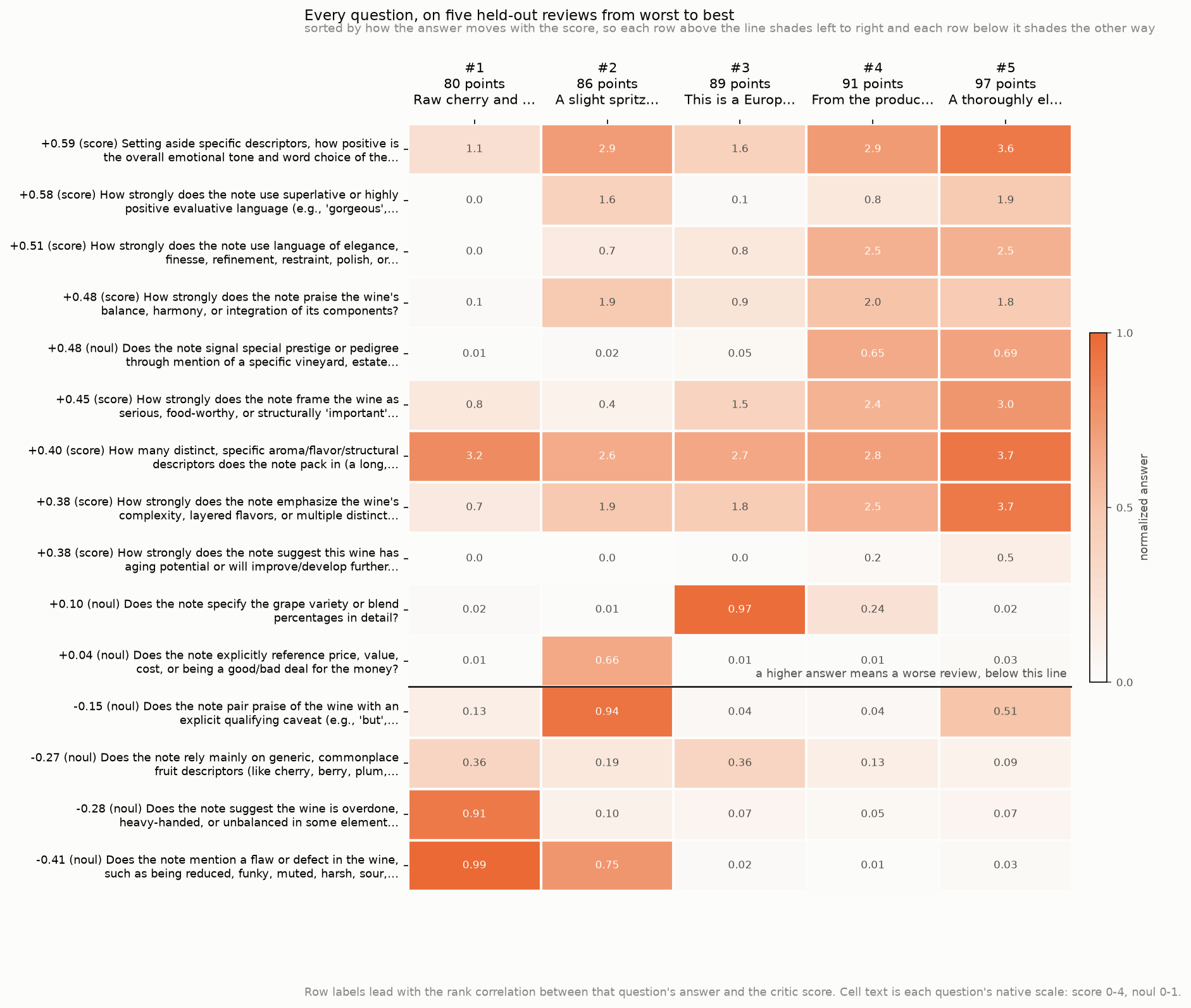
页面顶部的表格已经算好。五个 arm 在同一批 800 行 held-out 数据上各打分一次,前三个跳过 feature discovery。一个预测 dev 评分行的均值,根本不读评价文本。一个把评价交给同一个 CatBoost,通过其 text_features 处理变成词频统计。一个直接让 TypeSafe 来给出评分本身。
第三个是每行一道 Score,跨越十个档位(level),从「faulty or unpleasant」一直到「profound」。十个档位,因为十档已经是 Score 题型能接受的上限——十一个会返回服务端错误。Level 0 对应 80 分,level 9 对应 100 分。仅沿评分刻度这样铺开档位本身还不够,因为题目里没有任何信息说明这份出版物的评分实际落在哪个位置。因此每个答案随后再统一平移一个偏移量,这个偏移量在 dev 评分上测得。该偏移量打印在行标签中,也是这条捷径唯一从评分中学到的东西。
Spearman 是秩相关系数,1.0 表示 held-out 葡萄酒的排序恰好就是评论家的顺序。词频那一行是 CatBoost 自带的文本处理,不是经过调优的文本回归管线。所有这些都是同一份数据集上同一次循环运行的结果。
predicted = fit_predict(X, split)
text_predicted = fit_predict_text(split)

# ask TypeSafe for the score itself, one request per row
with ThreadPoolExecutor(max_workers=8) as pool:
    direct = list(pool.map(lambda note: ask_score(TYPESAFE_MODEL, note), NOTES))
asked = np.array([d["expected"] for d in direct])
shift = float(SCORES[DEV].mean() - asked[DEV].mean())  # one number, from the dev labels

# what one proposal call gets you, before any feedback: the set round 1 ended with
first_round, _ = design(snapshots[0], answers_for, ENCODING)

print(f"{'arm':<46}{'RMSE':>7}{'spearman':>10}")
for label, p in (
    ("predict the mean of the dev rows", np.full(len(TEST), SCORES[DEV].mean())),
    ("the note as word counts, same CatBoost", text_predicted),
    (f"ask for the score itself, shifted {shift:+.2f}", asked[TEST] + shift),
    (
        f"{len(snapshots[0])} questions from round 1, no loop",
        fit_predict(first_round, split),
    ),
    (f"{len(accepted)} questions after all {ROUNDS} rounds", predicted),
):
print(f"{label:<46}{rmse(SCORES[TEST], p):>7.3f}{spearman(SCORES[TEST], p):>10.3f}")arm RMSE spearman
predict the mean of the dev rows 3.088 -0.014
the note as word counts, same CatBoost 2.466 0.605
ask for the score itself, shifted -1.71 2.145 0.761
18 questions from round 1, no loop 1.869 0.778
38 questions after all 5 rounds 1.772 0.799自动研究的几轮有帮助吗?
两条线都绘制了每轮结束时问题集的误差,从第一次 proposal 开始。虚线是交叉验证的 dev 误差,是每次接受和拒绝决策的依据。实线在循环从未读过的同一批 held-out 行上对同一问题集打分。每个点代表该轮收官时问题集的状态,因此即使一轮只做了 revision 或 drop,两条线仍会一起移动。feature map 说明了问题度量什么;误差才能说明第一轮 proposal 之后的轮次是否让预测更准。
坐标轴范围很紧:图上发生的一切都在 0.2 分以内,上面表格里的所有捷径都远远位于图顶之外。dev 线全程位于 held-out 线之上,这是一种训练数据量效应。每个 dev 折叠只用四分之五的 dev 行训练,而 held-out 数字来自一个用上全部 1,200 行的模型。两条线一起移动,因此循环所依据的 dev 数字能跟随它从未见过的 held-out 数字。标题下的区间通过对 held-out 行重采样得到,因此它回答的是「第 1 轮到第 5 轮的提升是否大于 800 行的噪声」。
curve, per_round = [], []
for features in snapshots:
    X_round, _ = design(features, answers_for, ENCODING)
    per_round.append(fit_predict(X_round, split))
    curve.append((len(features), rmse(SCORES[TEST], per_round[-1])))

# the same held-out rows resampled 2,000 times, both arms scored on each resample
gain = paired_gain(SCORES[TEST], per_round[0], per_round[-1])
print(
    f"round 1 -> round {ROUNDS} on the held-out rows: {gain[0]:+.3f} points, "
    f"95% CI [{gain[1]:+.3f}, {gain[2]:+.3f}]"
)

fig = rounds_chart(plt, curve, history, len(TEST), gain)
display(fig)
plt.close(fig)round 1 -> round 5 on the held-out rows: -0.097 points, 95% CI [-0.147, -0.050]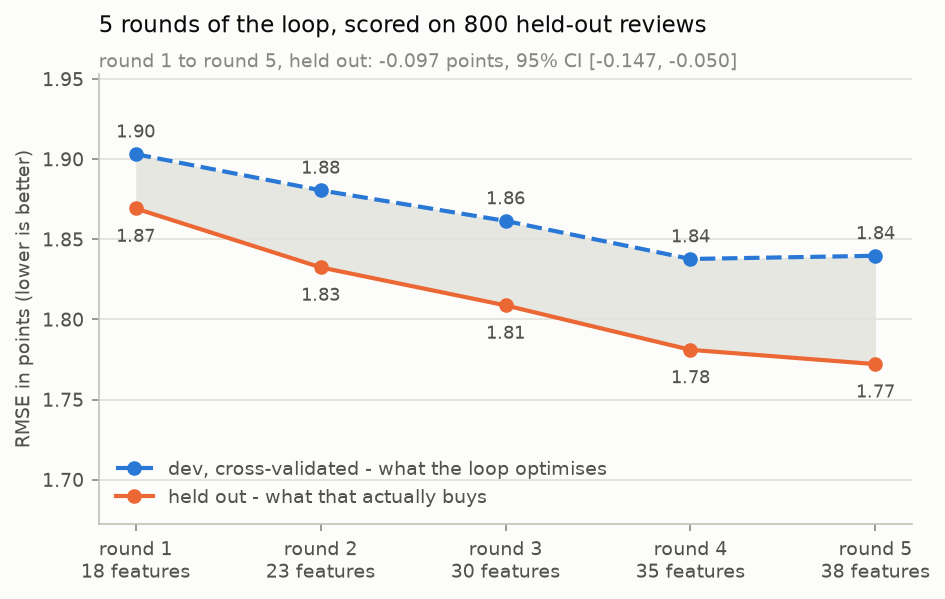
held-out 线比 dev 线跌得更深。第 1 轮在没有反馈的情况下写出了它的问题,之后四轮在 held-out 行上值 0.10 分,95% 置信区间 [-0.147, -0.050]。
第 5 轮提出了 4 个 add、2 个 reword 和 8 个 drop,并给出了第一个没有改善的 dev 数字。一段 245 个字符的评价能问的东西就这么多,到第 5 轮时,proposal 已经从「加问题」转向「删问题」。
kinds = {f["name"]: f["kind"] for f in accepted}
print("feature importance share: % of total CatBoost importance across all questions")
print(f"{'feature':<38}{'asked as':<10}{'importance share':>16}")
for name, importance_share in sorted(feature_importances.items(), key=lambda p: -p[1])[
    :12
]:
    kind = "score" if kinds[name] == "intensity" else "noul"
    print(
        f"{name[:36]:<38}{kind:<10}{importance_share:>8.1f}%  "
        f"{'#' * round(importance_share)}"
    )
counts = f"{sum(1 for k in kinds.values() if k == 'intensity')} score"
counts += f", {sum(1 for k in kinds.values() if k == 'presence')} noul"
print(f"\nthe {len(accepted)} questions the loop kept: {counts}")
top = max(feature_importances, key=feature_importances.get)
print(
    f'the question behind the top row:\n  {top}: "{owner_of(top, accepted)["question"]}"'
)feature importance share: % of total CatBoost importance across all questions
feature asked as importance share
note_overall_tone_positivity score 17.4% #################
savory_food_wine_seriousness score 8.7% #########
positive_superlative_language score 8.4% ########
single_vineyard_or_prestige_signal noul 7.2% #######
descriptive_detail_density score 5.7% ######
elegance_finesse_language score 5.0% #####
complexity score 5.0% #####
aging_potential score 5.0% #####
balance_harmony score 2.9% ###
drinkability_easiness score 2.9% ###
critic_enthusiasm_confidence score 2.7% ###
flavor_distinctiveness score 2.6% ###
the 38 questions the loop kept: 29 score, 9 noul
the question behind the top row:
note_overall_tone_positivity: "Setting aside specific descriptors, how positive is the overall emotional tone and word choice of the note taken as a whole (warm, admiring language throughout vs. flat, neutral, or lukewarm phrasing)?"importance share 是 CatBoost 的特征重要性(feature importance),归一化后所有 38 道题之和为 100%。它不是行数、问题数或预测准确率的占比。一道 Score 题占两列,一个均值和一个离散度,因此打印百分比前要把这两列的重要性加起来。note_overall_tone_positivity 占总量的 17.4%。第四行是一道 Noul:评价是否点名了单一葡萄园或其他声望信号,是一道是非类事实,因此被作为一道题提出。
下一步
这次运行把循环控制得很小。可以直接扩展的方向:
- 在花钱回答某个候选问题之前先筛掉一部分。把候选问题本身当作 state(上下文状态),针对它提 Noul(是非题):能否从源文本中作答、在其 criteria(判定标准)下是否只有一种含义、是否适用于大多数行、是否在不同行之间有变化。只把四项全部通过且置信度(confidence)足够高的问题发出去。
- 剪枝相关特征。在开发行上测量编码后列之间的相关性,把近似重复的聚成一类,从每类里保留最清晰或最重要的问题。
- 加入简单基线。单独对比 TF-IDF、字符数以及其他结构特征,然后把它们拼到发现出来的列之后,衡量各自贡献了多少。
- 混合提案模型族。用 Anthropic、OpenAI、Google Gemini 以及开源模型各自生成一批候选,在它们到达 TypeSafe 之前合并去重。不同模型族带来的搜索空间扩展,应该大于对同一个提案模型的重复调用。
- 比较不同的预测模型和方法。尝试线性回归或弹性网络回归、支持向量回归、随机森林,以及在下游输出是概率(probability)时进行再校准。看看这些发现的特征在 CatBoost 之外是否也有帮助。
- 加入 embedding 基线。embedding 把一条品鉴笔记变成几百个不带问题的数字:
sentence-transformers/all-MiniLM-L6-v2可以本地运行,OpenAI 的text-embedding-3-small是托管调用。把其中一个拼到发现出来的列之后,衡量它是否携带了这些列没有的信息。 - 让验证方式贴近部署。预测未来时用按时间切分,相关行必须在一起时用分组切分,并保留一份最终测试集,让它既不被特征发现过程碰到,也不被模型选择过程碰到。
- 在平台上停止。当交叉验证的 RMSE 连续若干轮不再提升,或者达到问题数或请求数预算时,结束循环。
- 在智能体(agent)的 Goal 模式下跑更长时间的搜索。给它一个明确的指标、预算和停止规则,然后让它多轮地提案、评估、打磨。
- 检查稳定性。跨多个随机种子或数据切片重复做特征发现,保留一直有用的那些问题,而不是只在某一次切分上显得重要的。
在 playground 中打开
这个分享链接中包含一条品鉴笔记以及循环最终留下的所有问题。
playground_link = make_playground_link(
    NOTES[0], feature_questions(accepted), models=[TYPESAFE_MODEL]
)
display(
    Markdown(
        f"🔗 [Open the note + questions in the TypeSafe playground]({playground_link})"
    )
)
在 TypeSafe playground 中打开笔记和问题 →
本文档由 Mintlify 构建并托管,Mintlify 是一个面向开发者的文档平台。